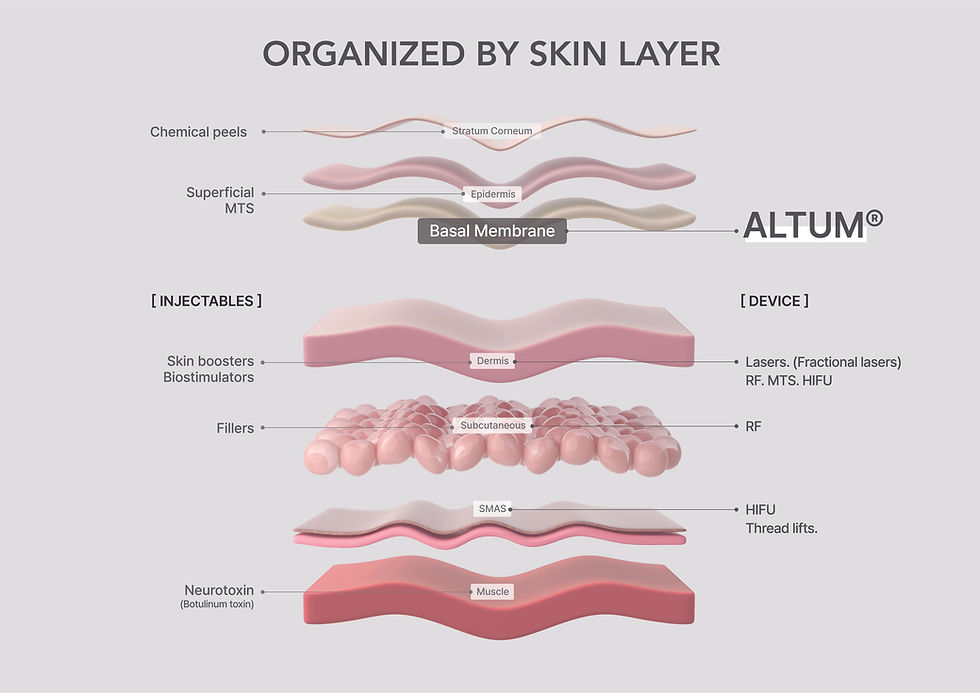
The Multi-Layer Approach: Why Skin treatment Requires targeting every depth?
A multilayer treatment is a procedural approach that targets multiple skin layers, using different technologies optimized for each depth.
Why a Multilayer Approach Is Needed?
Each treatment primarily targets a single skin layer, and its effects vary by treatment type.
Skin concerns are often multi-factorial, requiring a targeted strategy across all layers to enable synergistic improvements.
By combining treatments across layers, multilayer approaches enhance both structural and surface skin quality, supporting overall skin health.

“The EPCs can be affected by multiple tissue layers (i.e., skin surface quality can stem from and be impacted by deep structures or tissues). This means that topical approaches may not be sufficient. Instead, improving skin quality EPCs can require a multilayer treatment strategy.”
The Challenge of Targeting the basal membrane
Few treatments partially target the epidermis (Skinboosters and MTS), However, no treatments exist that specifically and effectively target only the basal membrane.
The Basal Membrane is the ultra-thin layer between the epidermis and dermis, essential boundary structure that supports the Basal Layer —the deepest layer of the epidermis containing all regenerative cells.
Why Basal membrane Targeting Is Difficult?
Thin layer
Epidermis is very thin (~0.05–0.1mm on most facial areas), and basal membrane is even thinner, which requires precise depth control.
Injection limitations
Needle depth and angle are difficult to control manually
Outcomes vary depending on practitioner skill
MTS limitations
Differences in facial contours and skin make it challenging to penetrate evenly.
Why Targeting the Basal membrane Matters

Treatments that reach the basal membrane can influence the skin’s natural renewal process and overall tone.
Critical epidermal cells influenced in the Basal Layer
Keratinocytes – regulate barrier function and repair
Melanocytes – determine pigmentation and contribute to skin tone
Stimulate Fibroblast: Stimulated keratinocytes release growth factors and cytokines, which cross the basal membrane and activate fibroblasts, promoting increased collagen and elastin production.
Basal membrane-targeted treatments can help address pigmentary concerns, support barrier recovery, and stimulate fibroblasts to enhance overall skin health.
ALTUM®: Precision Basal membrane Targeting
for Multilayer Treatments
ALTUM® is currently the only treatment capable of precisely targeting the basal membrane
Does not require injections or additional devices
By combining ALTUM® with other treatments, all skin layers can be effectively targeted, maximizing efficacy and supporting overall skin health.